

k means clustering
K-means clustering is a widely used unsupervised machine learning algorithm that aims to partition a dataset into distinct groups, or clusters, based on feature similarity. The algorithm operates by initializing a specified number of centroids, which represent the center of each cluster. It then iteratively assigns data points to the nearest centroid and recalculates the centroids based on the assigned points. This process continues until the centroids stabilize, resulting in clusters that ideally have minimal intra-cluster variance and maximal inter-cluster variance. K-means is particularly valued for its simplicity and efficiency in handling large datasets.

K-means Clustering
K-means Clustering is an unsupervised machine learning technique. It aims to partition n observations into k clusters. As we have seen in other Machine learning Algorithms, we have a loss function…
📚 Read more at Analytics Vidhya🔎 Find similar documents
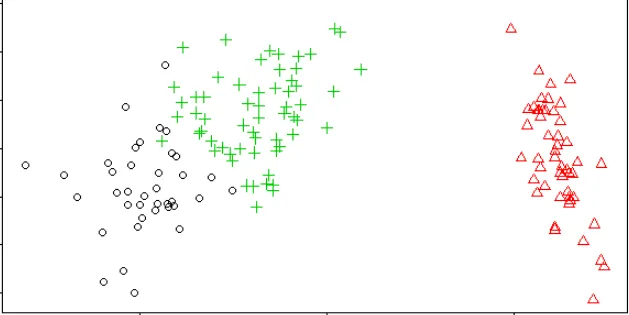
K-Means Clustering in R
K-means clustering is one of the most popular unsupervised learning methods in machine learning. This algorithm helps identify “k” possible groups (clusters) from “n” elements based on the distance…
📚 Read more at Towards Data Science🔎 Find similar documents
20x times faster K-Means Clustering with Faiss
k-Means clustering is a centroid-based unsupervised method of clustering. This technique clusters the data points into k number of clusters or groups each having an almost equal distribution of data…
📚 Read more at Towards Data Science🔎 Find similar documents
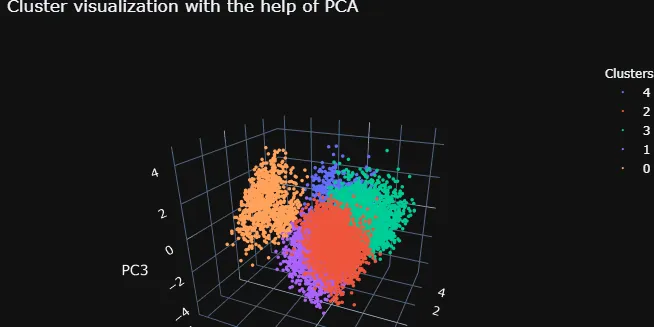
Selecting optimal K for K-means clustering
K-means clustering is a way of vector quantization, originally from signal processing that aims to cluster observations based on mean. Lets start with clarifying the premise of clustering case that…
📚 Read more at Towards Data Science🔎 Find similar documents
K-means Clustering Clearly explained
K-means clustering is an unsupervised machine learning algorithm, where its job is to find clusters within data. We can then use these clusters identified by the algorithm to make predictions for…
📚 Read more at Python in Plain English🔎 Find similar documents

K-Means Clustering Algorithm
Brief: K-means clustering is an unsupervised learning method. In this post, I introduce the idea of unsupervised learning and why it is useful. Then I talk about K-means clustering: mathematical…
📚 Read more at Level Up Coding🔎 Find similar documents
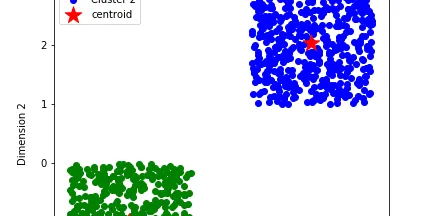
K-Means Clustering Algorithm
Brief: K-means clustering is an unsupervised learning method. In this post, I introduce the idea of unsupervised learning and why it is useful. Then I talk about K-means clustering: mathematical…
📚 Read more at Analytics Vidhya🔎 Find similar documents

K-means clustering: find my tribe!
K-means clustering has many potential applications in data analysis problems where relationships among large number of samples need to be discovered. The concept behind the technique is quite simple…
📚 Read more at Towards Data Science🔎 Find similar documents

K-Means Clustering From Scratch
K-means clustering (referred to as just k-means in this article) is a popular unsupervised machine learning algorithm (unsupervised means that no target variable, a.k.a. Y variable, is required to…
📚 Read more at Towards Data Science🔎 Find similar documents

One Stop for K-Means Clustering
How to cluster similar data points such that it makes sense? Well, K-Means is one of the answers. This article wraps up pretty much everything about K-Means clustering. Well, that being said, I didn’t...
📚 Read more at Towards AI🔎 Find similar documents

K-means Clustering in a Nutshell
K-means is an unsupervised clustering machine learning model. In Unsupervised Learning, the data set does not contain a target value to train the data. Clustering is a technique in which we group…
📚 Read more at Towards AI🔎 Find similar documents

“K-means Clustering” in 200 words.
K-means is a machine learning algorithm designed to find “clusters” in data by measuring the “distance” between points. This is typically done through the “elbow method” by plotting the “error” of…
📚 Read more at Analytics Vidhya🔎 Find similar documents