

FastAPI Documentation
The “FastAPI Documentation” provides a comprehensive guide on using FastAPI, a modern web framework for building APIs with Python. It covers topics such as routing, request handling, data validation, dependency injection, security, and more. The documentation offers detailed explanations, code examples, and best practices for leveraging FastAPI’s features efficiently. Users can learn how to create high-performance APIs, handle asynchronous operations, integrate with databases, and deploy applications. Overall, the FastAPI Documentation serves as a valuable resource for developers looking to streamline API development processes using Python.
 Visit FastAPI Documentation
FastAPI
FastAPI Ìlànà wẹ́ẹ́bù FastAPI, iṣẹ́ gíga, ó rọrùn láti kọ̀, o yára láti kóòdù, ó sì ṣetán fún iṣelọpọ ní lílo Àkọsílẹ̀ : https://fastapi.tiangolo.com Orisun Kóòdù : https://github.com/tiangolo/fastap...
📚 Read more at FastAPI Documentation🔎 Find similar documents
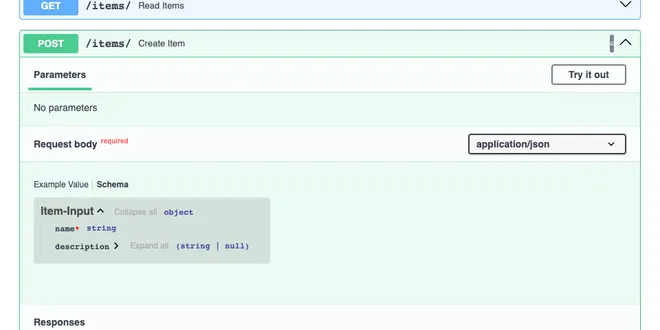
Separate OpenAPI Schemas for Input and Output or Not
Separate OpenAPI Schemas for Input and Output or Not When using Pydantic v2 , the generated OpenAPI is a bit more exact and correct than before. 😎 In fact, in some cases, it will even have two JSON ...
📚 Read more at FastAPI Documentation🔎 Find similar documents

Deploy FastAPI on Cloud Providers
Deploy FastAPI on Cloud Providers You can use virtually any cloud provider to deploy your FastAPI application. In most of the cases, the main cloud providers have guides to deploy FastAPI with them. ...
📚 Read more at FastAPI Documentation🔎 Find similar documents

SQL (Relational) Databases with Peewee
SQL (Relational) Databases with Peewee Warning If you are just starting, the tutorial SQL (Relational) Databases that uses SQLAlchemy should be enough. Feel free to skip this. Peewee is not recommend...
📚 Read more at FastAPI Documentation🔎 Find similar documents

General - How To - Recipes
General - How To - Recipes Here are several pointers to other places in the docs, for general or frequent questions. Filter Data - Security To ensure that you don't return more data than you should, ...
📚 Read more at FastAPI Documentation🔎 Find similar documents
Async SQL (Relational) Databases with Encode/Databases
Async SQL (Relational) Databases with Encode/Databases Info These docs are about to be updated. 🎉 The current version assumes Pydantic v1. The new docs will include Pydantic v2 and will use SQLModel...
📚 Read more at FastAPI Documentation🔎 Find similar documents

NoSQL (Distributed / Big Data) Databases with Couchbase
NoSQL (Distributed / Big Data) Databases with Couchbase Info These docs are about to be updated. 🎉 The current version assumes Pydantic v1. The new docs will hopefully use Pydantic v2 and will use O...
📚 Read more at FastAPI Documentation🔎 Find similar documents

GraphQL
GraphQL As FastAPI is based on the ASGI standard, it's very easy to integrate any GraphQL library also compatible with ASGI. You can combine normal FastAPI path operations with GraphQL on the same ap...
📚 Read more at FastAPI Documentation🔎 Find similar documents

Conditional OpenAPI
Conditional OpenAPI If you needed to, you could use settings and environment variables to configure OpenAPI conditionally depending on the environment, and even disable it entirely. About security, A...
📚 Read more at FastAPI Documentation🔎 Find similar documents

Custom Request and APIRoute class
Custom Request and APIRoute class In some cases, you may want to override the logic used by the Request and APIRoute classes. In particular, this may be a good alternative to logic in a middleware. F...
📚 Read more at FastAPI Documentation🔎 Find similar documents

Custom Docs UI Static Assets (Self-Hosting)
Custom Docs UI Static Assets (Self-Hosting) The API docs use Swagger UI and ReDoc , and each of those need some JavaScript and CSS files. By default, those files are served from a CDN . But it's poss...
📚 Read more at FastAPI Documentation🔎 Find similar documents

Extending OpenAPI
Extending OpenAPI There are some cases where you might need to modify the generated OpenAPI schema. In this section you will see how. The normal process The normal (default) process, is as follows. A...
📚 Read more at FastAPI Documentation🔎 Find similar documents