

Natural Language Processing with Python
“Natural Language Processing with Python” delves into the realm of language understanding and processing using the Python programming language. The document explores the application of Python in various contexts, such as AI applications like Langchain, data augmentation for machine learning, and deterministic bridge engineering. It discusses the importance of maintaining conversation history in AI applications, the challenges of generative AI in enterprise settings, and the utilization of tools like Spark, EMR, and Airflow for building secure and responsive systems. The content highlights the significance of context, precision, and data pipelines in enhancing the capabilities of natural language processing technologies.
 Visit Natural Language Processing with Python
ch03.rst2
🔎 Find similar documents

2. Accessing Text Corpora and Lexical Resources
Practical work in Natural Language Processing typically uses large bodies of linguistic data, or corpora . The goal of this chapter is to answer the following questions: What are some useful text corp...
📚 Read more at Natural Language Processing with Python🔎 Find similar documents

1. Language Processing and Python
It is easy to get our hands on millions of words of text. What can we do with it, assuming we can write some simple programs? In this chapter we'll address the following questions: What can we achieve...
📚 Read more at Natural Language Processing with Python🔎 Find similar documents

Preface
This is a book about Natural Language Processing. By "natural language" we mean a language that is used for everyday communication by humans; languages like English, Hindi or Portuguese. In contrast t...
📚 Read more at Natural Language Processing with Python🔎 Find similar documents

ch04.rst2
🔎 Find similar documents

9. Building Feature Based Grammars
Natural languages have an extensive range of grammatical constructions which are hard to handle with the simple methods described in 8. . In order to gain more flexibility, we change our treatment of ...
📚 Read more at Natural Language Processing with Python🔎 Find similar documents

8. Analyzing Sentence Structure
Earlier chapters focused on words: how to identify them, analyze their structure, assign them to lexical categories, and access their meanings. We have also seen how to identify patterns in word seque...
📚 Read more at Natural Language Processing with Python🔎 Find similar documents

10. Analyzing the Meaning of Sentences
We have seen how useful it is to harness the power of a computer to process text on a large scale. However, now that we have the machinery of parsers and feature based grammars, can we do anything sim...
📚 Read more at Natural Language Processing with Python🔎 Find similar documents

11. Managing Linguistic Data
Structured collections of annotated linguistic data are essential in most areas of NLP, however, we still face many obstacles in using them. The goal of this chapter is to answer the following questio...
📚 Read more at Natural Language Processing with Python🔎 Find similar documents

5. Categorizing and Tagging Words
Back in elementary school you learnt the difference between nouns, verbs, adjectives, and adverbs. These "word classes" are not just the idle invention of grammarians, but are useful categories for ma...
📚 Read more at Natural Language Processing with Python🔎 Find similar documents
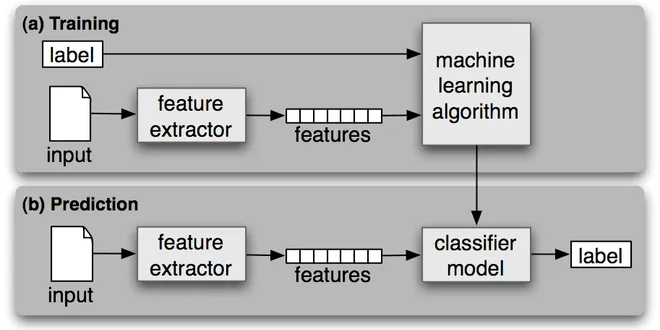
6. Learning to Classify Text
Detecting patterns is a central part of Natural Language Processing. Words ending in -ed tend to be past tense verbs ( 5. ). Frequent use of will is indicative of news text ( 3 ). These observable pat...
📚 Read more at Natural Language Processing with Python🔎 Find similar documents

7. Extracting Information from Text
For any given question, it's likely that someone has written the answer down somewhere. The amount of natural language text that is available in electronic form is truly staggering, and is increasing ...
📚 Read more at Natural Language Processing with Python🔎 Find similar documents