

Think Bayes
“Think Bayes” is a comprehensive guide that delves into the world of Bayesian statistics and probabilistic programming. The book explores how to apply Bayesian methods to solve real-world problems, emphasizing practicality and hands-on learning. It covers topics such as Bayesian inference, probability theory, and probabilistic programming using Python. Through a combination of theoretical explanations and practical examples, “Think Bayes” aims to equip readers with the knowledge and skills needed to understand and implement Bayesian statistical analysis effectively. The book serves as a valuable resource for individuals looking to deepen their understanding of Bayesian statistics and its applications.
 Visit Think Bayes
Comparing birth rates
Run this notebook on Colab Here’s an exercise that was in a draft of Think Bayes , but I ended up cutting it. Exercise: Two doctors fresh out of medical school are arguing about whose hospital delive...
📚 Read more at Think Bayes🔎 Find similar documents

Think Bayes 2
by Allen B. Downey Think Bayes is an introduction to Bayesian statistics using computational methods. Think Bayes is a Free Book. It is available under the Creative Commons Attribution-NonCommercial-...
📚 Read more at Think Bayes🔎 Find similar documents

Preface
The premise of this book, and the other books in the Think X series, is that if you know how to program, you can use that skill to learn other topics. Most books on Bayesian statistics use math notat...
📚 Read more at Think Bayes🔎 Find similar documents

Probability
The foundation of Bayesian statistics is Bayes’s Theorem, and the foundation of Bayes’s Theorem is conditional probability. In this chapter, we’ll start with conditional probability, derive Bayes’s T...
📚 Read more at Think Bayes🔎 Find similar documents

Bayes’s Theorem
In the previous chapter, we derived Bayes’s Theorem: \[P(A|B) = \frac{P(A) P(B|A)}{P(B)}\] As an example, we used data from the General Social Survey and Bayes’s Theorem to compute conditional probab...
📚 Read more at Think Bayes🔎 Find similar documents

Distributions
In the previous chapter we used Bayes’s Theorem to solve a cookie problem; then we solved it again using a Bayes table. In this chapter, at the risk of testing your patience, we will solve it one mor...
📚 Read more at Think Bayes🔎 Find similar documents

Estimating Proportions
In the previous chapter we solved the 101 Bowls Problem, and I admitted that it is not really about guessing which bowl the cookies came from; it is about estimating proportions. In this chapter, we ...
📚 Read more at Think Bayes🔎 Find similar documents
Estimating Counts
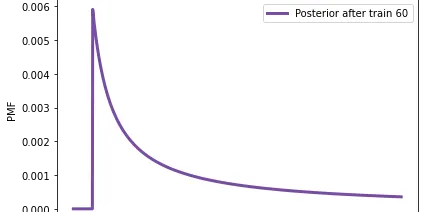
In the previous chapter we solved problems that involve estimating proportions. In the Euro problem, we estimated the probability that a coin lands heads up, and in the exercises, you estimated a bat...
📚 Read more at Think Bayes🔎 Find similar documents

Odds and Addends
This chapter presents a new way to represent a degree of certainty, odds , and a new form of Bayes’s Theorem, called Bayes’s Rule . Bayes’s Rule is convenient if you want to do a Bayesian update on p...
📚 Read more at Think Bayes🔎 Find similar documents
Minimum, Maximum, and Mixture
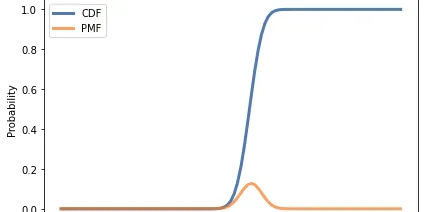
In the previous chapter we computed distributions of sums. In this chapter, we’ll compute distributions of minimums and maximums, and use them to solve both forward and inverse problems. Then we’ll l...
📚 Read more at Think Bayes🔎 Find similar documents
Poisson Processes
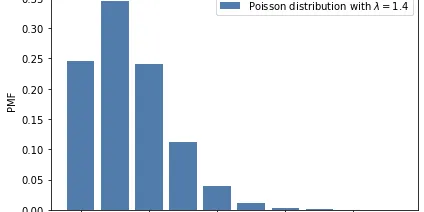
This chapter introduces the Poisson process , which is a model used to describe events that occur at random intervals. As an example of a Poisson process, we’ll model goal-scoring in soccer, which is...
📚 Read more at Think Bayes🔎 Find similar documents

Decision Analysis
This chapter presents a problem inspired by the game show The Price is Right . It is a silly example, but it demonstrates a useful process called Bayesian decision analysis . As in previous examples,...
📚 Read more at Think Bayes🔎 Find similar documents