

JSON&YAML serialization
JSON and YAML are popular formats used for data serialization, which involves converting data structures into a format that can be easily stored or transmitted. JSON (JavaScript Object Notation) is lightweight and widely used for APIs and web applications due to its simplicity and ease of use. YAML (YAML Ain’t Markup Language), on the other hand, is designed for human readability and is often preferred for configuration files. Both formats support various data types, including strings, numbers, and booleans, and YAML is a superset of JSON, meaning any valid JSON is also valid YAML. Understanding their differences and use cases is essential for effective data management.

JSON vs YAML
Any person with an interest in programming and technology knows what JSON is. YAML is not as common as JSON, but it is also a popular and awesome data serialization language. For example, any person…
📚 Read more at Level Up Coding🔎 Find similar documents
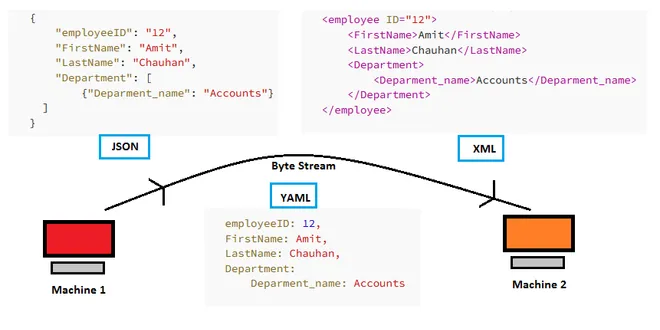
What are XML, JSON, and YAML Serialization Formats for AI Applications?
Serialization is a type of language format that is used to convert the object and transmit it to a file, database, or stream of bytes. When we want to send data from one machine to another machine…
📚 Read more at Python in Plain English🔎 Find similar documents
YAML Tutorial: Everything You Need To Know in 5 Mins
YAML Ain’t Markup Language (YAML) is a serialization language like XML and JSON. It is a superset of JSON, mainly used for configuration files. You can create a YAML file with either .yaml or .yml as…...
📚 Read more at Level Up Coding🔎 Find similar documents
— JSON encoder and decoder
json — JSON encoder and decoder Source code: Lib/json/__init__.py JSON (JavaScript Object Notation) , specified by RFC 7159 (which obsoletes RFC 4627 ) and by ECMA-404 , is a lightweight data interch...
📚 Read more at The Python Standard Library🔎 Find similar documents
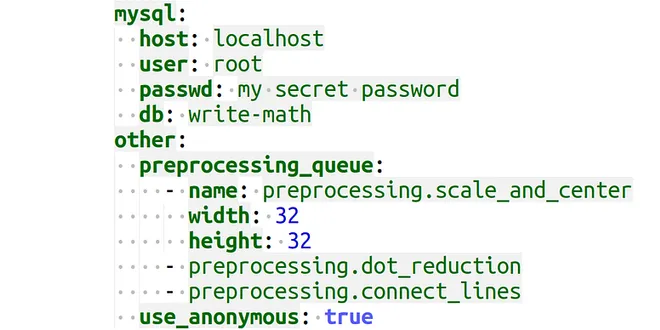
6 YAML Features most programmers don’t know
YAML is a file format commonly used for data serialization. There are a plethora of projects using YAML files for configuration, such as Docker-compose, pre-commit, TravisCI, AWS Cloudformation…
📚 Read more at Level Up Coding🔎 Find similar documents

My love affair with JSON
For me, JSON (JavaScript Object Notation) is a delightful data sharing/transfer format to use. It is simple to use and read. It is very fast to process. It is also subset of YAML which is even easier…...
📚 Read more at Towards Data Science🔎 Find similar documents

Serialization
Versions [{“Name”:“Java SE 1.1”,“GroupName”:null},{“Name”:“Java SE 1.2”,“GroupName”:null},{“Name”:“Java SE 1.3”,“GroupName”:null},{“Name”:“Java SE 1.4”,“GroupName”:null},{“Name”:“Java SE 5”,“GroupName...
📚 Read more at Essential Java🔎 Find similar documents

Serialization with Jackson 2
Following is an implementation that demonstrates how an object can be serialized into its corresponding JSON string. class Test { private int idx; private String name; public int getIdx() { return idx...
📚 Read more at Essential Java🔎 Find similar documents

Understanding Jackson Serialization, Deserialization, and Spring Boot Custom Jackson Modules
What is Jackson Serialization? Serialization is the process of converting a Java object into a JSON string. This is useful when you want to send Java objects over the network, save them to files, or i...
📚 Read more at Javarevisited🔎 Find similar documents
Serialisation in REST APIs Java (and java generics)
In the context of REST APIs, serialisation is the process of converting data objects in a program into a format that can be transmitted over a network. The data objects are typically in the form of ob...
📚 Read more at Javarevisited🔎 Find similar documents

Everything You Need to Know About YAML
According to Wikipedia YAML (/ˈjæməl/ and YAH-ml) is a human-readable data-serialization language. It is commonly used for configuration files and in applications where data is being stored or…
📚 Read more at Better Programming🔎 Find similar documents
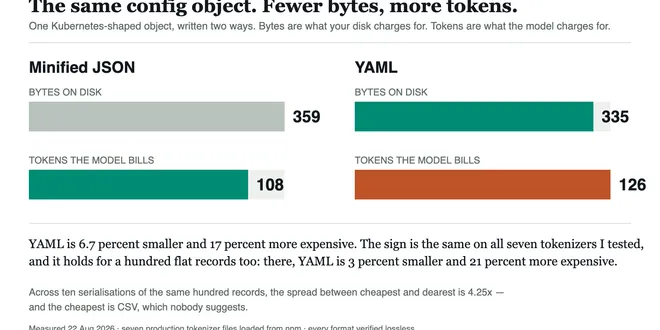
GPT-5, Llama And Qwen Agree: YAML Is Smaller Than JSON And Costs More Tokens
Ten serialisations, seven production tokenizers. Across a hundred records YAML is 3% fewer bytes than minified JSON and 21% more tokens —… Continue reading on Towards AI
📚 Read more at Towards AI🔎 Find similar documents