


Object Relational Mapping
Object Relational Mapping (ORM) is a programming technique that facilitates the interaction between object-oriented programming languages and relational databases. By providing a high-level abstraction, ORMs allow developers to manipulate database records as if they were regular objects in their code, eliminating the need for complex SQL queries. This approach streamlines data handling, making it easier to create, read, update, and delete records. However, while ORMs can enhance productivity and simplify database interactions, they may also introduce challenges such as performance issues and increased complexity in certain scenarios. Understanding the balance between using ORMs and direct SQL is essential for effective database management.

Object Relational Mapper
In practice, an ORM acts as an abstraction layer between the application code and the relational database, significantly simplifying the management of stored data. This means that we can manipulate da...
📚 Read more at Python in Plain English🔎 Find similar documents

Part VI: SQL and Object Relational Mapping
Part VI: SQL and Object Relational Mapping In this part of the book we're going to cover something that doesn't quite fit into the rest of the book's structure, but is a very necessary topic for junio...
📚 Read more at Learn More Python 3 The Hard Way🔎 Find similar documents
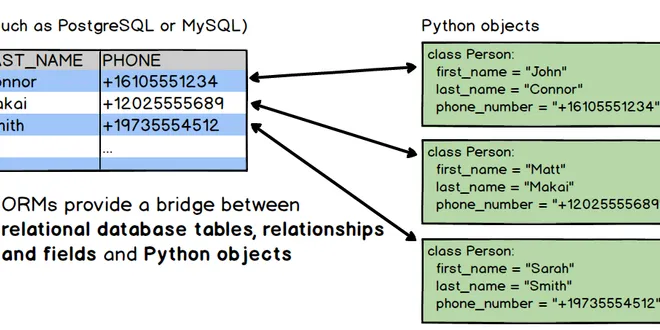
Object-relational Mappers (ORMs)
Object-relational mappers (ORMs) bridge relational databases and data represented in Python code.
📚 Read more at Full Stack Python🔎 Find similar documents

Building the Rust Web App — How to Use Object-Relational Mapper
Building the Rust Web App — How to Use Object-Relational Mapper To maximize your benefits with containers Photo by Federico Bottos on Unsplash This is the third part of a multi-part series about writ...
📚 Read more at Better Programming🔎 Find similar documents

How I built a simple ORM from scratch in Python
An ORM (Object Relational Mapper) is a tool that allows you to interact with your database using the object-oriented paradigm. Therefore, ORMs are generally implemented as libraries in languages that…...
📚 Read more at Level Up Coding🔎 Find similar documents

Stop Importing Models Manually in Flask
What is ORM? ORM, or Object-Relational Mapping, is a technique used in programming to convert data between incompatible type systems using object-oriented programming languages. In simpler terms, ORM ...
📚 Read more at Python in Plain English🔎 Find similar documents
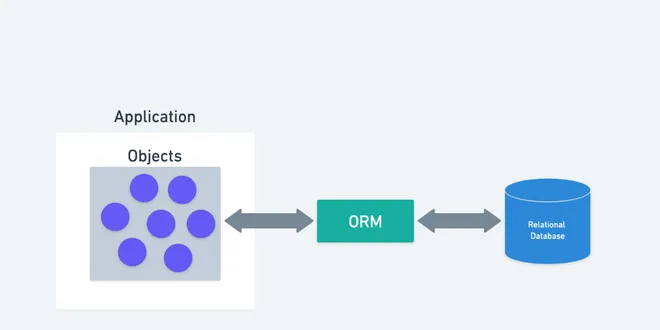
Why ORMs Are Not Always the Way To Go
Photo by Alain Bouchard on Unsplash For many, using an Object Relational Mapper (ORM), like hibernate in Java, has become almost automatic. While ORMs are incredibly powerful and useful tools, their u...
📚 Read more at Better Programming🔎 Find similar documents
Model Field - Django ORM Working - Part 2
The last post covered the structure of Django Model. This post covers how the model field works, what are the some important methods and functionality and properties of the field. Object-Relational Ma...
📚 Read more at Technical Ramblings🔎 Find similar documents
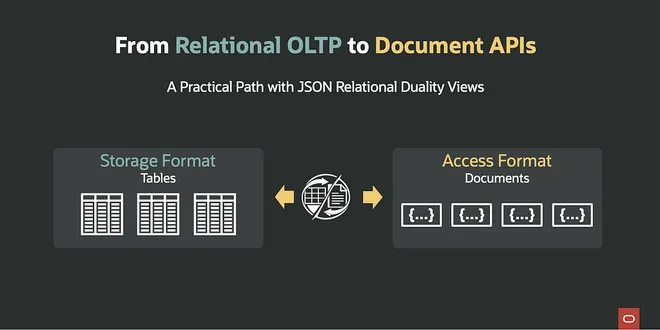
From Relational OLTP to Document APIs: A Practical Path with JSON Relational Duality Views
Keep the relational schema exactly where it is. Modernize your enterprise application by adding a document API layer on top. Key Takeaways * Duality Views bridge the impedance mismatch between relati...
📚 Read more at Oracle Developers🔎 Find similar documents
ORM in Django
ORM refers to object-relational mapping. It lets you interact with the database using Python, like you do it with SQL. It is primarily designed for relational databases like PostgreSQL, MySQL, Oracle,...
📚 Read more at Python in Plain English🔎 Find similar documents

Modeling Real Objects
CircleCalculator objects allow us to easily compute the circumference and area of a circle if we know its radius. We really need to create only one CircleCalculator object, because if want to compute ...
📚 Read more at Object-oriented Programming in Java🔎 Find similar documents

Radial Treemaps: Extending Treemaps to Circular Mappings
Background The Treemap Concept The “Treemap” was introduced by Ben Shneiderman at the University of Maryland in the early 1990s¹. Simply put, it’s an efficient way of displaying hierarchical data as a...
📚 Read more at Towards Data Science🔎 Find similar documents